
In 1738, Charles de Bourbon, King of Naples and Sicily, decided to build a palace in Naples, on the hill of Capodimonte, overlooking the Bay of Naples. From the outset, he wanted not only a residence for himself and his court, but also a prestigious place to house the magnificent art collection he had inherited from his mother, Elizabeth Farnese. This is the core of the Capodimonte Museum collection, which has grown steadily over the years to become one of Italy’s finest museums.


Two dynasties have played an important role in building the museum’s collections: the Farneses and the Bourbons.
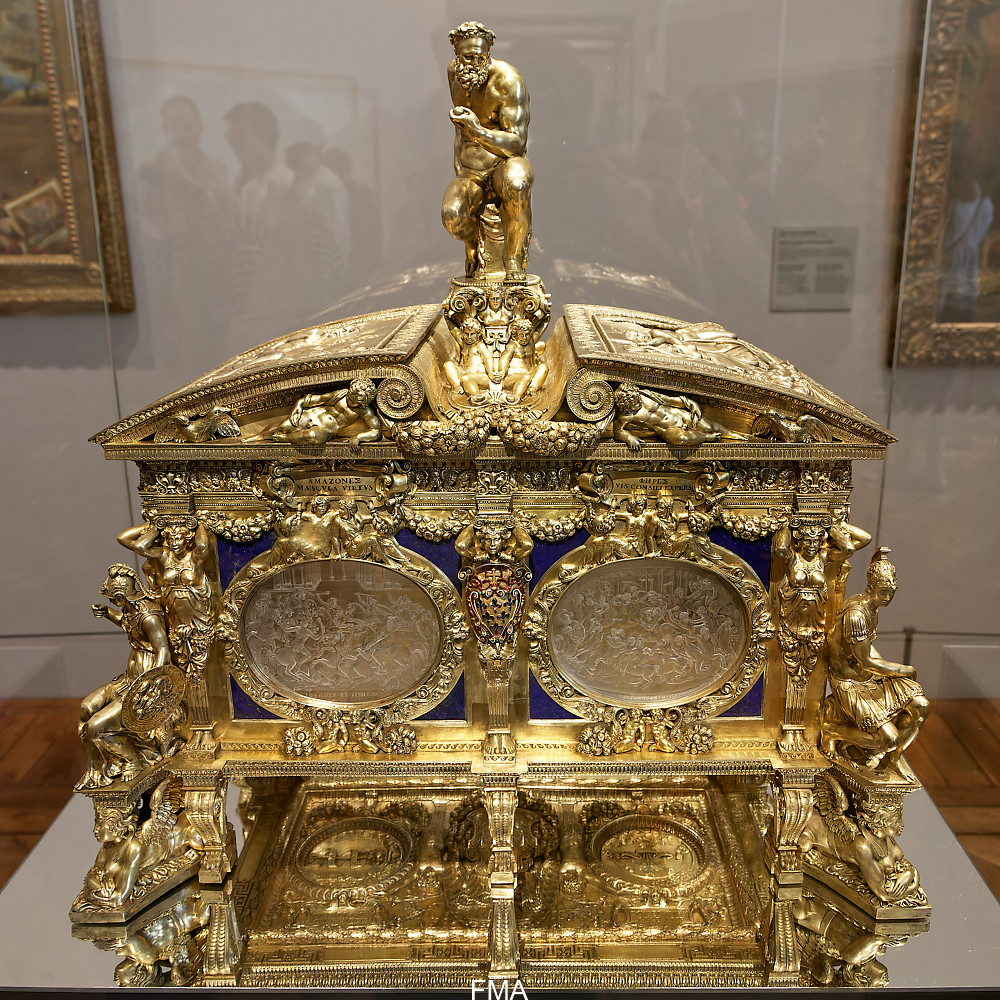
First of all, the Farnese family is a great family of Roman collectors. From the Renaissance onwards, with Cardinal Alexander Farnese and Pope Paul III Farnese among others, the family built up an immense collection of antiques and works of the great Italian schools, and commissioned magnificent works of art such as the « Farnese Cassette ».


The Bourbon dynasty built the palace, enriched the collections and developed a porcelain factory that supplied many masterpieces.

This porcelain piece was destined to adorn the banqueting hall. It depicts Zeus, atop the pyramid, striking down the Giants. Due to the exceptional size of the piece, it took a long time to complete.
This extraodinary collection gives us an overview of Italian painting, on the one hand, and Neapolitan painting, on the other
The early Renaissance, in the 15th century, is well represented by works by Masaccio, Masolino and Bellini.
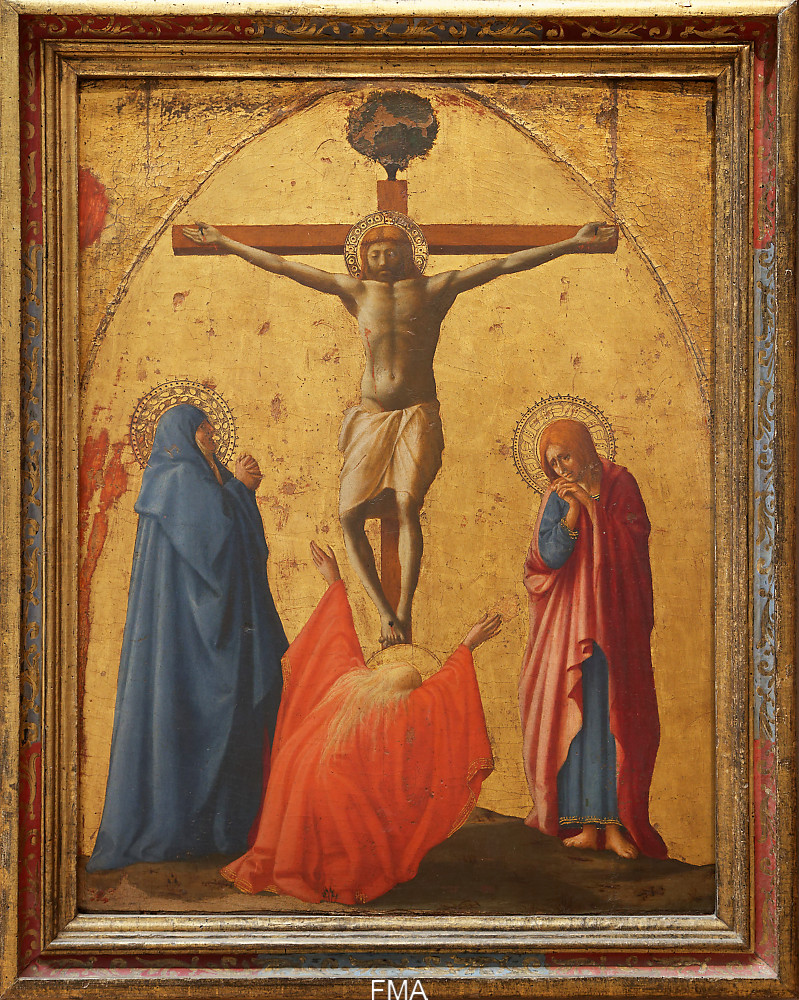
Art historians consider Masaccio to be one of the founders of Renaissance painting, and one of the inventors of geometric perspective. In this panel, Magdalene, from the back, invites us to enter the scene and share the characters’ despair at Christ’s death. Although he retained certain criteria inherited from the Middle Ages, such as the gilded background, the painter introduced a new pictorial language: attention to body volumes and emotional expression. He also innovated by introducing perspective. Indeed, Christ’s head seems too far back in the shoulders. However, this panel was at the top of a polyptych, five meters above the ground. This strange foreshortening allows us to take into account the viewer’s lower vantage point, and creates the illusion of a forward-leaning face.
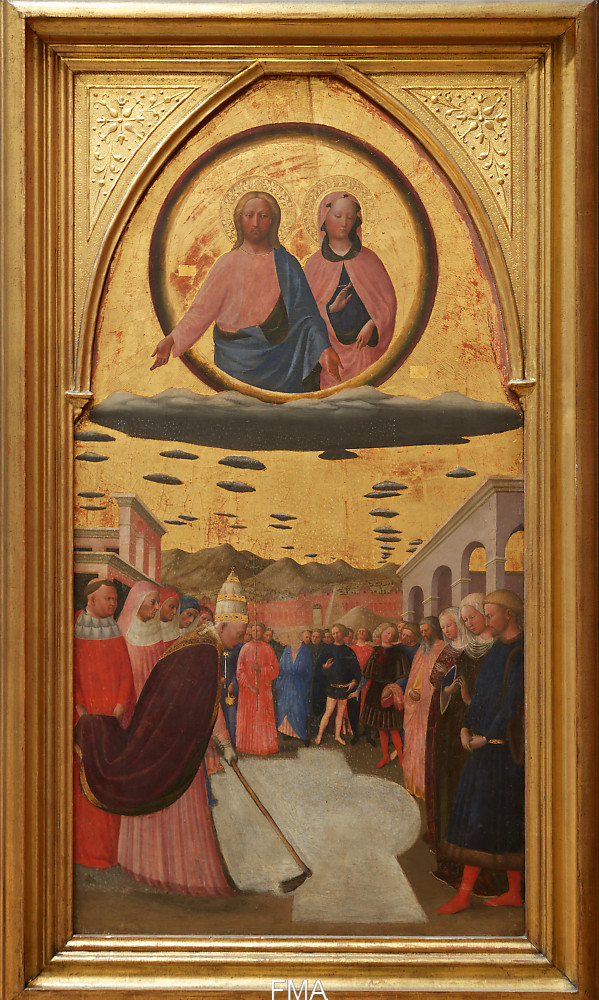
According to legend, a heavy snowfall occurred in Rome between August 4 and 5, 1352, during a very hot August, drawing the outline of a church on the Esquiline hill. Pope Liberus decided to build the Basilica of Santa Maria Maggiore on this site. A collaborator of Masaccio, Masolino remained strongly influenced by late Gothic. He was nonetheless attentive to Masaccio’s innovations in architectural perspective and clouds.

In a peaceful atmosphere, Bellini sets the scene of the Transfiguration, an extraordinary event in which, for an instant, Jesus shows his divine essence. The figures are treated in antique style (their volumes are emphasized by a complex interplay of draperies), but the most admirable element is the landscape. The artist pays particular attention to the realistic representation of the elements (rocks, foreground vegetation, wooden fence). The calm landscape in the background, drowned in light and populated by buildings, paths and figures, is totally innovative.
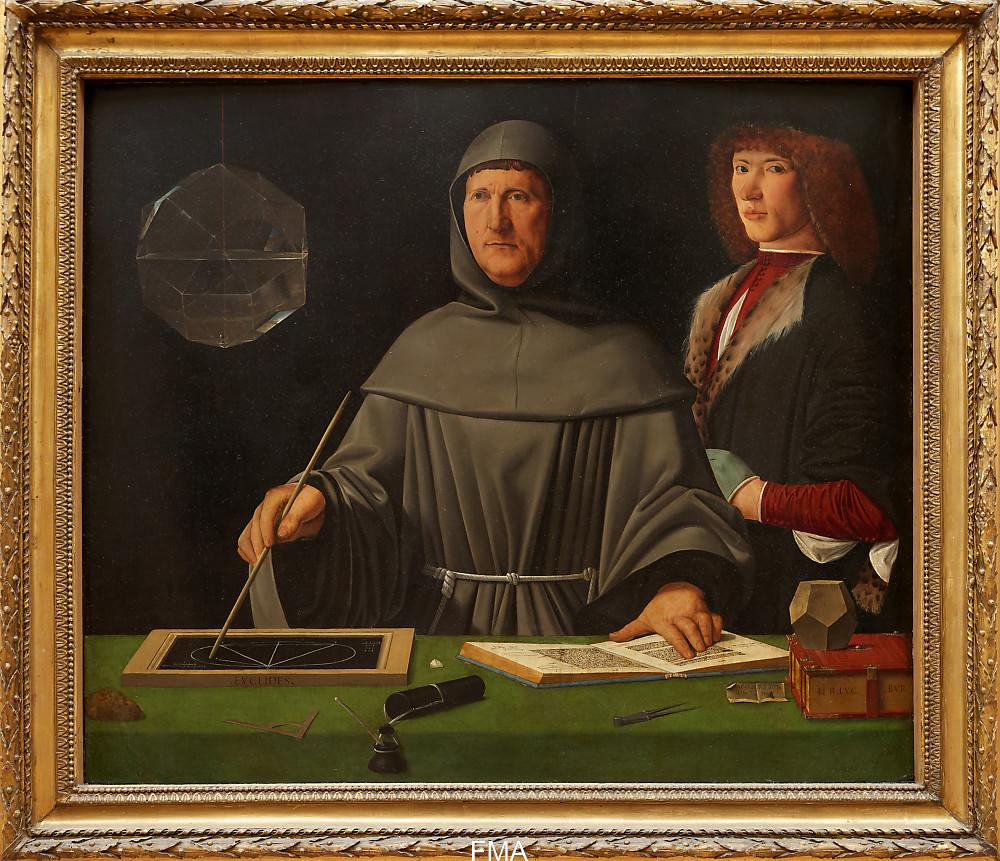
Luca Pacioli, a Franciscan monk, was a great mathematician. He is shown with books, measuring instruments and geometric shapes in the foreground. Associating a character with objects that define his activities or knowledge is characteristic of Renaissance portraits.
Our discovery continues with works from the so-called « classical » Renaissance, from the early 16th century.
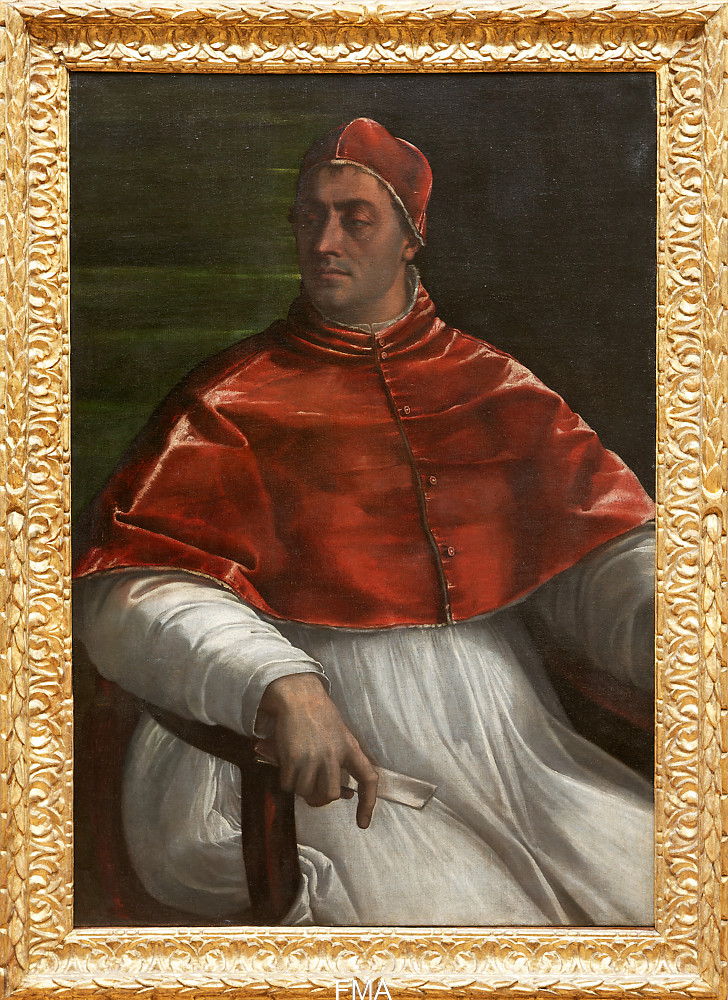
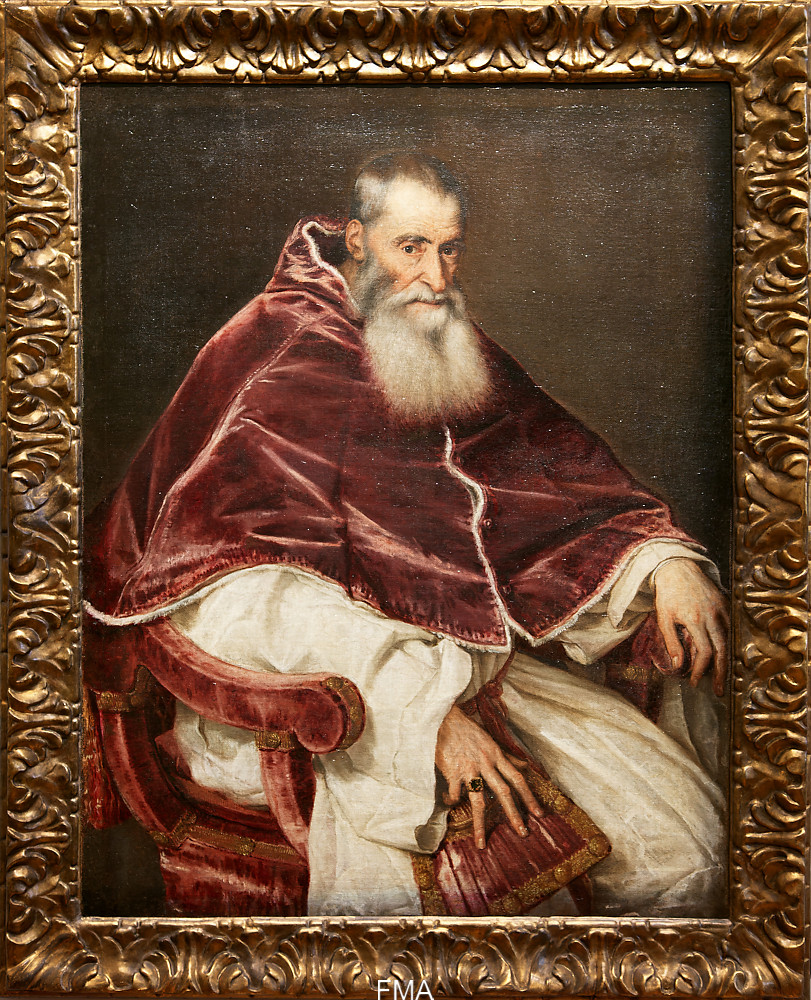
The painter uses the traditional pose for a pope’s portrait: seated, oblique and « cut » at the knees. He gives it an impressive mummumentality. With virtually no accessories, the eye can focus on the model’s clothing and deliberate face.

Set against an emerald-green background, the young bishop’s face is shown realistically (dark circles, skin imperfections). His presence is accentuated by a violent light coming from the viewer’s space, fading the red color of the garment.
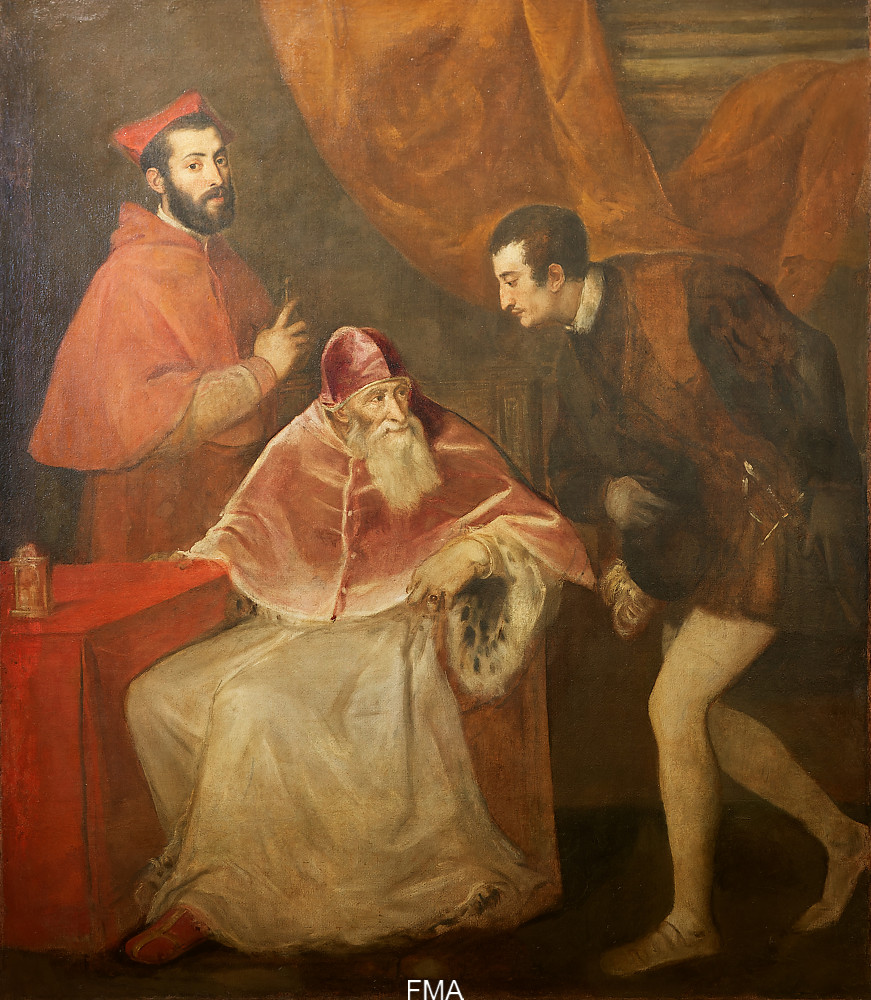
Titian monumentalizes his subject by using a large format and painting his models life-size. The Pope, shown seated, seems weighed down by the weight of his years as much as by the weight of his sumptuous costume. His grandsons are depicted in radically different attitudes. While Alexander, in the background, appears stiff as a statue, Octavian is shown in full movement.

The delicately modeled body of Danae’s figure is a summit of eroticism.
The collection is also rich in Mannerist and Baroque works.

The accumulation of objects in this painting shows what a perfect gentleman should be, both a warrior and a man of refinement.
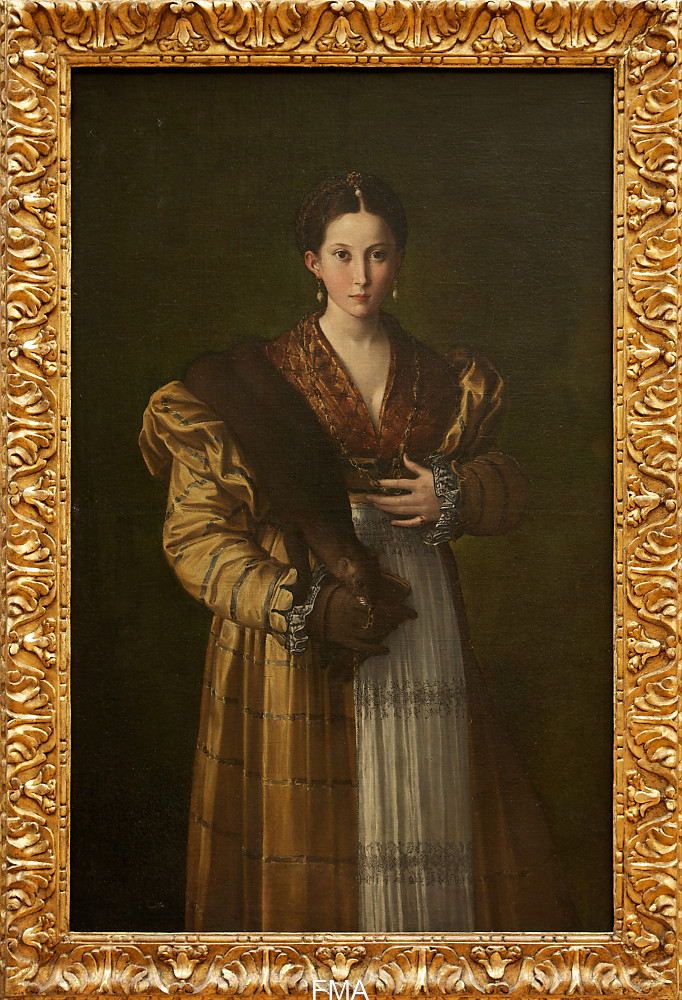
At first glance, all we see is the young woman’s enigmatic face and opulent costume. Then we notice the violent contrast between the white hand holding the necklace and the gloved hand that appears to be bitten by the sable worn on the shoulder.

Inspired by Michelangelo’s sculpted Pietà, Carracci emphasizes the proximity of the Virgin to her son by resting Christ’s head in her hand. The pyramidal construction includes an angel supporting Christ’s left hand. A second little angel points to the crown of thorns, taking the viewer as witness to Jesus’ Passion.
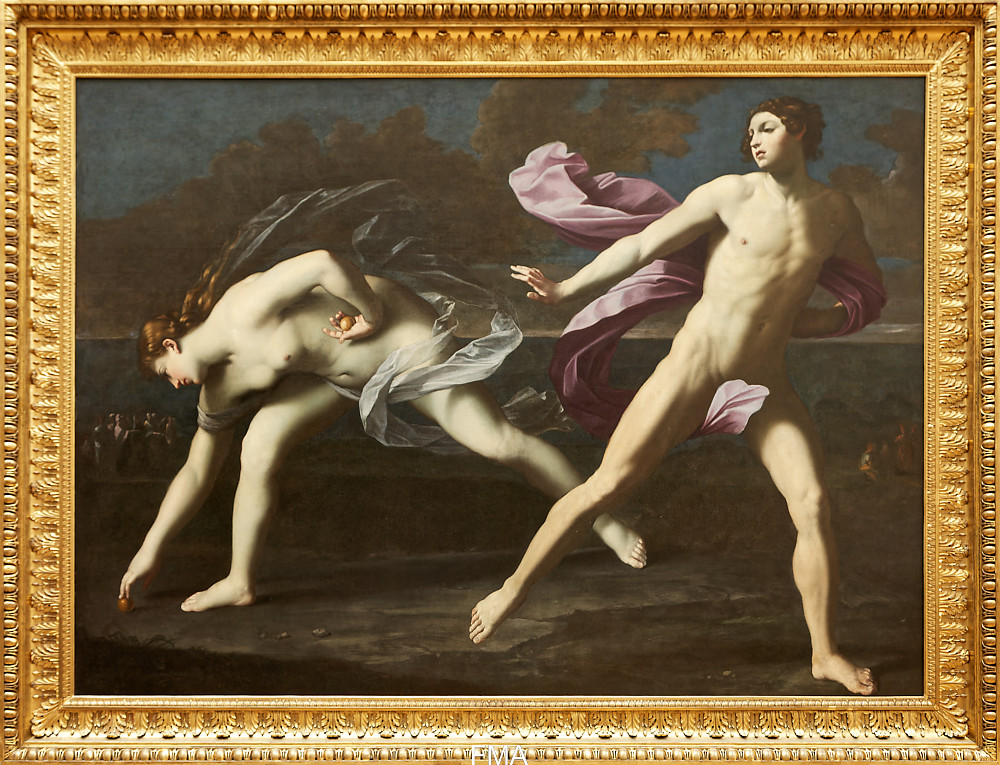
The theme, taken from Ovid’s Metamorphoses, tells the story of Atalanta, who agrees to marry only on condition that her suitors succeed in beating her in a race. In love, Hippomenes, aided by Venus, succeeds by dropping three apples from the Hesperides garden. Each time Atalanta bends down to pick them up, the young man can get a head start.
As you’d expect, the Capodimonte Museum boasts a rich collection of works by artists from southern Italy, and Neapolitan artists in particular. The collection spans the period from the 12th to the 18th century, although the most prolific period is that of Baroque painting.

Around a huge Saint Vincent Ferrier, a 15th-century Dominican preacher, panels recount episodes from his life, alternating exterior and interior scenes. Endowed with a great sense of narrative, Colantonio shows that he assimilated both the innovations of central Italy and the Flemish manner.
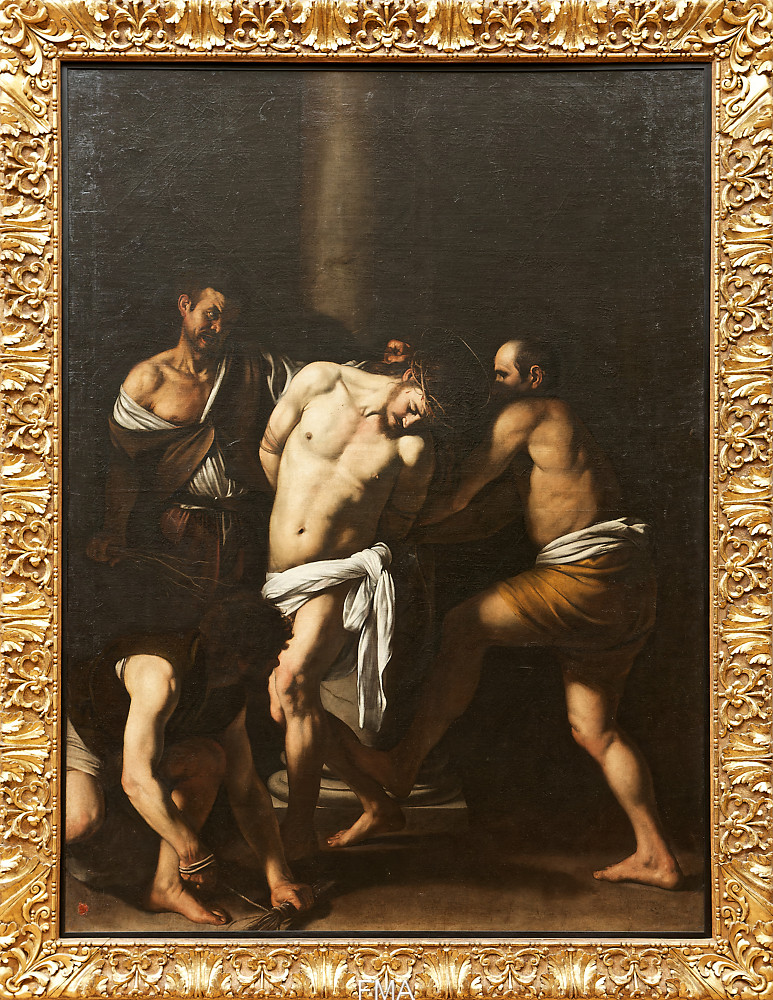
Having fled Rome in 1606, Caravaggio settled for a time in Naples, where he painted this Flagellation for a chapel in the church of San Domenico Maggiore. Caravaggio’s art is built on a dramatic use of light. Here, a bright light highlights the perfectly white body of Christ. It contrasts with the bestiality of the executioners, cast in shadow. Caravaggio’s naturalism marked a turning point in the history of painting in Naples, and inspired many painters in the first half of the 17th century.

Inspired by Caravaggio, Ribera, a Spanish painter based in Naples, worked with light and chiaroscuro. He paid particular attention to naturalistic rendering, both in still life and in his depiction of old age

Also inspired by Caravaggio, both in theme and style, Artemisia Gentileschi depicts a scene of rare violence with very tight framing. She succeeds in rendering tangible the energy deployed by the two women to subdue Holofernes.
The second half of the 17th century was dominated by two important figures: Mattia Preti and Luca Giordano. It was also a period that saw the development of still life painting.

Mattia Preti combines the influences of Caravaggio and Ribera. The figure of his Saint Sebastian occupies the entire canvas and is imbued with a certain theatricality.

Nicknamed « Luca fa presto » for his speed of execution, Luca Giordano produced large, brightly colored compositions.

Giuseppe Recco is one of the leading 17th-century still-life specialists. He possessed a keen sense of observation and an incomparable talent for rendering the textures and colors of nature.
I hope this article will inspire you to dive into the treasures of this magnificent exhibition at the Musée du Louvre. My choice of works is not exhaustive, of course, and there are many more to delight your eyes.
Naples in Paris. The Louvre invites the Capodimonte Museum, until January 8, 2024
 L'Art en Tête